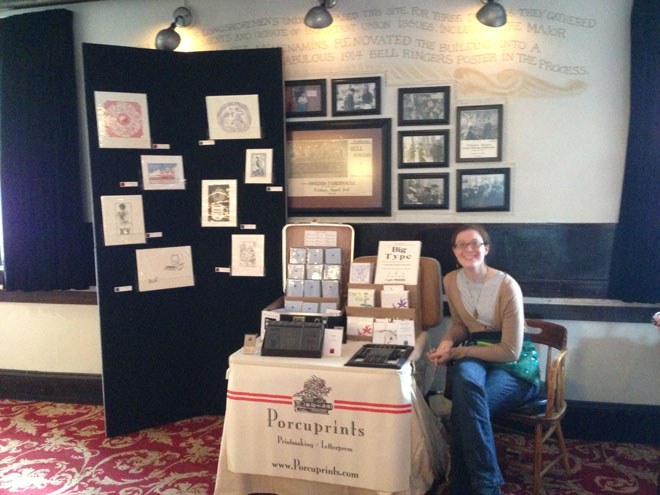
Porcuprints Featured in Blog
Rebecca Tomb, on Etsy as BeckyTDesigns, just featured Porcuprints on her blog!
Here’s her feature!: http://beckytdesigns.blogspot.com/2011/12/featured-etsian.html
New Etsy Listing
My latest listing on Etsy has just gone live! It is a hand-colored version of “Don’t Play Koi with Me!” I used calligraphy inks and watercolors for the color. Also, I added a calligraphy gold ink in the tail and body to make the koi fish scales pop!
Click on the image to see the Etsy listing and more photographs!
Final Press Photographs
Every part of the Kelsey press has finally been put back together! And here are pictures!

The only thing missing are the roller hooks. The old ones are bent and I believe we will have to make new ones. Other than that, it’s finished.
This is what it looked like BEFORE:

And AFTER:


The next step is to make a beautifully crafted wooden base for the press. This will stabilize the press and have handles for more easily carrying.
Give the Gift of Art
“Don’t Play Koi with Me” was featured in a wonderful treasury this evening! Kelly Tankersley from 88editions put together a treasury featuring some wonderful artists, including my piece.
Thanks Kelly! You made my day!
December’s First Friday Art Walk
It’s that time of the month again! December’s First Friday Art Walk is upon us! Don’t forget to show support for Etsy sellers on December 2nd.

For those of you who don’t know, FFAW is Etsy’s version of going on a First Friday art gallery walk/tour. Except here you don’t have to leave your couch. Just cuddle up to your loved one, or a nice glass of wine, and search Etsy for “firstfridayartwalk.” I promise you will discover some extraordinary artists!
Press Restoration Update: Grease & Shims
Shims and grease are two things that are quite important when reassembling a press, and I did not want them to get lost in the glitz and glam of retaining rings and finished pictures. While they aren’t as pretty, they are necessary!
Shims:
When we first started fitting the dowels in the press, I noticed that some of the cast parts were rubbing quite hard against each other. This was removing paint, and could easily wear the castings over time. In the places that this occurred, I cut some circles out of some plastic shim stock (I think I used .003mm thickness). I didn’t want to add a thick layer between the castings. I just wanted to put a buffer between the castings to reduce metal-on-metal rubbing.
One of the places that needed a shim was at the top of the goose neck (or bow). This part attaches to the carriage and is under a bit of tension when fitted together. I REALLY don’t want to have to replace a broken carriage or a broken goose neck, so avoiding wearing either of these castings is a high priority!

I also made shims for one of the handle connections, and maybe one or two other places where my press needed it. I assume that each press is different through, so where you put shims may be totally different from where I needed them.
Grease:
This press probably had not been greased for a good 30 years or more. Now that it was all clean and had new dowels, it needed new grease. One of the advantages of having access to a machine shop is also having access to some things that one might not otherwise be able to get (or at least get cheaply).
The grease we used for the press was Teijin Seiki’s Molywhite RE No. 00. This is a lubricating grease is used specifically for manufacturing robots and robotic gears!

Of course, this high end lubricating grease worked amazingly well. I am quite sure that others will know of more appropriate greases to use on a press, but this is what we had access to. It produced smooth movement throughout the press.
Finishing touches and final assembly photos to follow!
Press Restoration Update: Cutting & Fitting New Dowels
When I first disassembled the Kelsey press I knew that I would have to replace the original dowels that held the parts together. The majority had been mushroomed on one end and deformed with a chisel and hammered into the other. I can only assume that this was done by the Kelsey company to stop people from taking the press apart. These presses really weren’t meant to last as long as they have, so I suppose replacing the dowels was not a priority for the Kelsey Co. Either that, or a previous owner replaced the rods very badly.

The original dowels were all covered in old stray paint, grease, and decades of gunk. There was even a place where someone had tried to replace one of the dowels with a nut and bolt that didn’t fit:

Needless to say, we decided to replace the dowels. We bought a 1/2″ diameter stainless steel, mill-finished rod from McMaster-Carr (one of Doug’s absolute favorite mail order parts places) and brass retaining rings to fit.
We went with stainless steel because it is hard, doesn’t rust, and will last forever. And, instead of re-mushrooming the dowels, we decided to use retaining rings to hold the rods in place. Retaining rings are amazing little fasteners that are designed to fit into a groove on a shaft. Once installed, the retaining ring holds the shaft in place. We got brass ones for no other reason than they would look beautiful when contrasted with the stainless steel rod and the black paint. I am sure you could use any number of different types and materials of retaining rings.
Because we were using the machine shop at Doug’s work, I was not allowed to work the lathe. That was all on Doug. So I wielded the CAMERA!

For each replacement dowel, we rough cut a piece of the rod approximately 1/2-3/4″ too long on each side, fitting the rod within the press pieces just to check.

Then Doug got on the lathe and (1) finished one end of the dowel, (2) cut a groove into the side of the dowel about 1/8″ in from the end (for the retaining ring), and (3) filed the edge down for a smooth bevel.

(You can see in the picture above that Doug has already cut the groove for the retaining ring and is in the process of filing the edge down.)
We then fit each dowel individually. We put a retaining ring on the finished side and slipped the dowel into its space. We then marked where the second retaining ring needed to be placed and Doug did the same thing for the other side.

Not only do the brass retaining rings look quite elegant, they also allow us to pull the dowels out easily, should we ever need to fix and/or replace them.

Press Restoration Update: Reassembling the Platen
The platen portion of the Kelsey Letterpress is made up of two main castings, the platen and the platen back. These two pieces are held together with a very strong spring held in place by a dowel. The screws on the platen back are not for holding the pieces together, but rather for adjusting the impression pressure.
BEFORE:

When I first removed the dowel platen back, the dowel holding the spring in place was deformed and the impression screws had been stuck in place by the bad spray painting job.
As with all the press parts, I sandblasted the paint off and primed and repainted both the platen and the platen back. The original impression screws were old round headed “stove bolts,” covered in spray-paint and rather beat up. So we decided to replace them (and the nuts). We went with stainless steel socket head cap screws. The advantage to this type of screw head is that it holds the hex key captive and allows for a more precise adjustment for the impression screw. We chose stainless steel both for its durability and because it matched the stainless steel rod we got to replace the original dowels holding the press parts together.

(we also replaced the nuts with new stainless steel ones and added washers between the nut and the casting to avoid wear on the contact point.)
Getting new screws was easy, but figuring out how to re-compress the spring AND re-insert the dowel was more complicated. Luckily Doug has access to a machine shop and scrap aluminum. He managed to create a little spring compression jig to hold the screw in place while inserting the dowel:

He drilled a hole in a chunk of aluminum that was just wider than the spring holder/guide on the platen. He then cut two grooves into the jig (wider than the hole for the dowel pin). We then put the jig into use with the Arbor press:

An arbor press is a small hand operated press that is typically used for punches, inserting rivets, and things like that. In this case, we used the strength of the arbor press to compress the spring. We fit the platen and platen back together, put the spring over the spring holder/guide, and topped it off with Doug’s new aluminum spring jig.

The arbor press compressed the spring easily, and the grooves that Doug cut were just deep enough to expose the hole for the dowel pin.

The dowel slipped in nicely and when the pressure was removed the spring was in place and perfectly tensioned. I should probably mention that I used the original spring. I just removed all the old paint, cleaned it up, and rubbed some paste wax on it to protect it and minimize rust.

The final assembly came together very nicely! The shiny new hardware looks great against the new black paint job.

Coming soon, the final assembly of the whole press!
Turkey Day & Holiday SALE!
For this very special holiday season, I am offering a Turkey Day & Holiday Sale! From Black Friday (Nov. 25) until December 18th, get 10% off everything in my Etsy Store! Just enter coupon code HOLIDAY2011 at checkout!